What Face Shape Do I Have? The Definitive Guide for Women
Find your face shape in 60 seconds — no tape measure required. AI maps 468 landmarks for a blend percentage, not a forced single label.
FaceShapeDetector Editorial Team
What Face Shape Do I Have? Start Here
Your face shape is determined by four measurements: forehead width, cheekbone width, jaw width, and face length. The relationships between these four numbers place you in one of six shape categories — or more accurately, in a blend between two.
Most guides tell you to get a tape measure. Skip it. Self-measurement in a mirror introduces error at every step. An AI that maps 468 precise facial landmarks gives you a more accurate result in 10 seconds.
The Blend Rule
Research shows most people are a blend of two shapes — not a clean single label. A result like "78% oval + 22% heart" is more useful than just "oval" because it tells you how much correction or balance you actually need in styling decisions.
The 6 Face Shapes — At a Glance
| Shape | Key Feature | Styling Goal | Common Mistake |
|---|---|---|---|
Oval | Slightly longer than wide, gently rounded | Maintain balance — most styles work | Overthinking — just pick what you like |
Round | Equal length + width, full cheeks | Add vertical length | Blunt chin-level cuts that widen |
Square | Strong angular jaw, equal widths | Soften with waves and texture | Sharp bobs that duplicate the jaw line |
Heart | Wide forehead, narrow pointed chin | Add width at jaw level | Volume at crown — the opposite of what's needed |
Diamond | Wide cheekbones, narrow forehead + jaw | Balance top and bottom | Avoiding bangs — they actually help here |
Oblong | Notably longer than wide | Add horizontal width | Long straight hair that adds more length |
How Do You Actually Identify Your Face Shape?
Step 1: Find your widest point. Pull your hair back and look straight at a mirror or camera. Where is your face widest — at the forehead, cheekbones, or jaw?
Step 2: Look at your jaw. Is it angular and defined (square), soft and rounded (round/oval), or narrow and pointed (heart/diamond)?
Step 3: Compare length vs. width. Does your face look noticeably longer than wide (oval/oblong), or does it appear roughly equal in both dimensions (round/square)?
These three checks narrow it down. But most people find themselves between two categories — which is exactly why a blend percentage matters more than a single label.
Quick Identification: Which Shape Are You?
- Forehead is widest, chin is narrow and pointed:: Heart shape. Your widest point is at the temples or brow. A 2020 NIH study rated heart-shaped faces among the highest for perceived attractiveness.
- Face is roughly as wide as it is long, jaw is soft:: Round shape. Full cheeks and minimal jaw definition are the giveaway.
- Face is roughly equal in length and width, jaw is angular:: Square shape. Research found only about 11% of people have a true square face — it's less common than most think.
- Cheekbones are the widest point, both forehead and jaw are narrower:: Diamond shape. The cheekbone prominence is the dominant feature.
- Face is noticeably longer than wide with a straight jawline:: Oblong shape. Often confused with oval — the key difference is oblong has a straighter, more parallel jaw.
- Slightly longer than wide, gently rounded, proportional:: Oval shape. The most versatile shape for styling — almost any cut, frame, or look works.
What Face Shape Is Most Common?
Oval and round are the most frequently occurring shapes in most populations. Research from an Australian population study found that only approximately 11% of people have a square face shape — significantly fewer than most people assume. Heart and oval faces rated highest for attractiveness in a 2020 NIH-published facial analysis study.
Importantly, the majority of people are blends — a pure single shape is less common than a 70/30 or 60/40 mixture between two types.
What Your Face Shape Means for Styling
Haircuts
Each shape has cuts that flatter and cuts that work against it. Oval gets universal freedom; round needs vertical emphasis; heart needs jaw-level width.
Glasses Frames
Contrast is the rule. Round faces need angular frames. Square faces need rounded frames. The face shape tells you which direction to go.
Brow Shape
Your brow arch angle and tail direction should complement your face shape. Brows are one of the most powerful levers for perceived facial symmetry.
Why AI Detection Is More Accurate Than a Chart
Traditional face shape charts ask you to compare your reflection to an illustration. The problems:
- Self-perception bias — people consistently see themselves differently than objective measurement shows
- Mirror distortion — even slight head tilt changes perceived proportions
- Forced single label — charts make you pick one shape when most people are between two
AI detection maps 468 precise facial landmark points and calculates exact ratios. It returns a blend percentage — like 75% oval + 25% heart — rather than forcing a single label. This is both more accurate and more useful for making actual styling decisions.
The Bottom Line
Stop trying to fit your face into one box. Get a blend percentage — it tells you which shape you lean toward and how much, which makes every styling decision more precise.
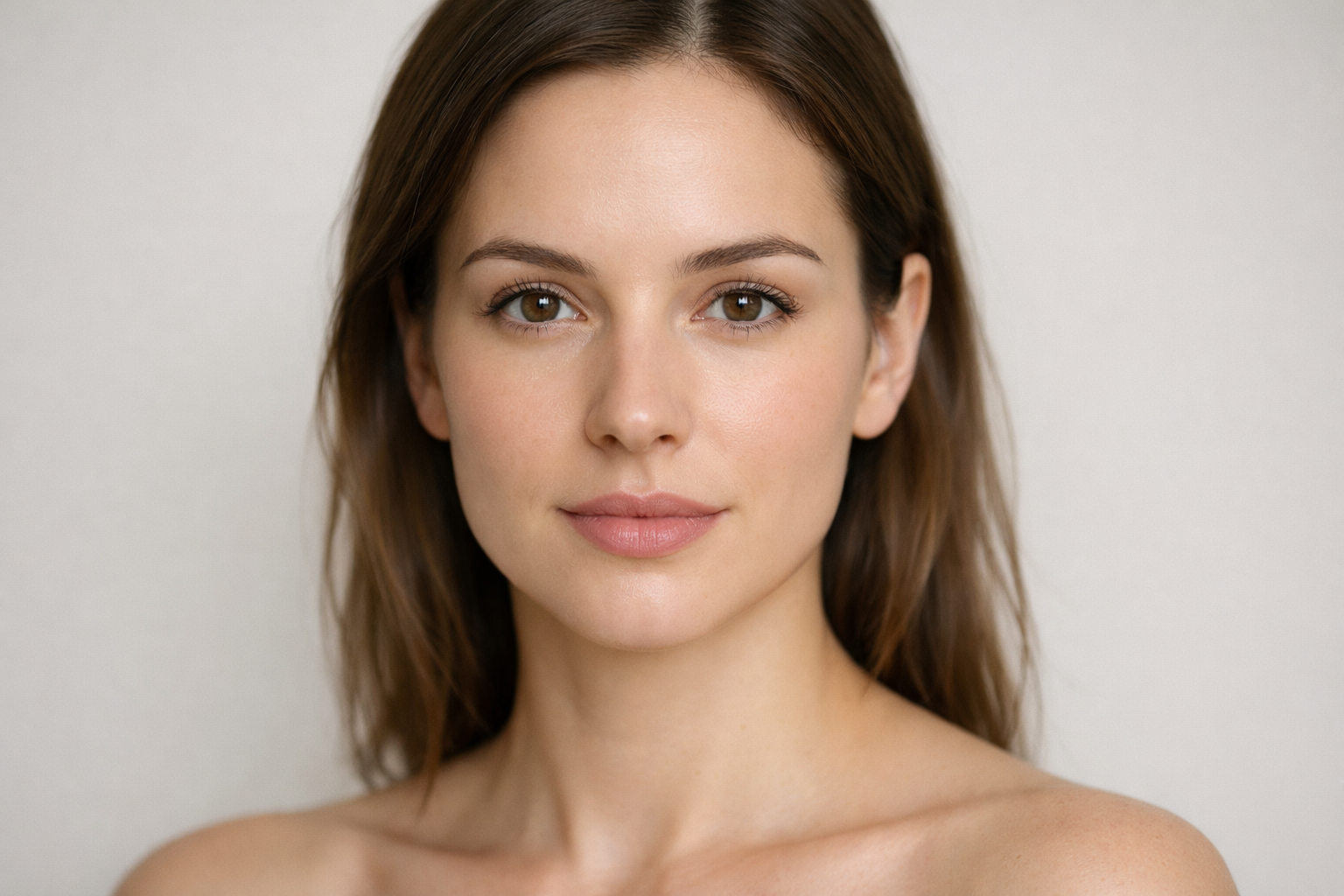
Upload a front-facing photo to FaceShapeDetector. You'll have your Face Shape Blend™ in 10 seconds.
Style Reference